
Advanced customization (functions)
Updated on November 28, 2026
This article only applies to the OxiMailing software.
OxiMailing lets you personalize your message with the fields of your recipient list (see Customize the message).
For example, if you have the person’s first and last name in your address list, you can set the email subject to: “For the attention of {{prenom}} {{nom}}”.
Each recipient will receive a personalized message (“For the attention of John Smith”, for example).
Personalization functions go one step further: they choose a text according to rules (the “conditions”).
Let’s say your list contains a “Title” field (Mr, Mrs…), and you want to create a “Greeting” function that shows “Dear Mr.” or “Dear Ms.” depending on the title. Personalization functions let you do that!
How to use them?
In your campaign, step “1 Recipients”, click “Functions” (next to “Columns”). You can also, in step “2 Message”, click the button that inserts a field, to the right of the “Subject”, then “Manage my functions…” at the bottom of the list. Then click “Create a function” (or “New”):
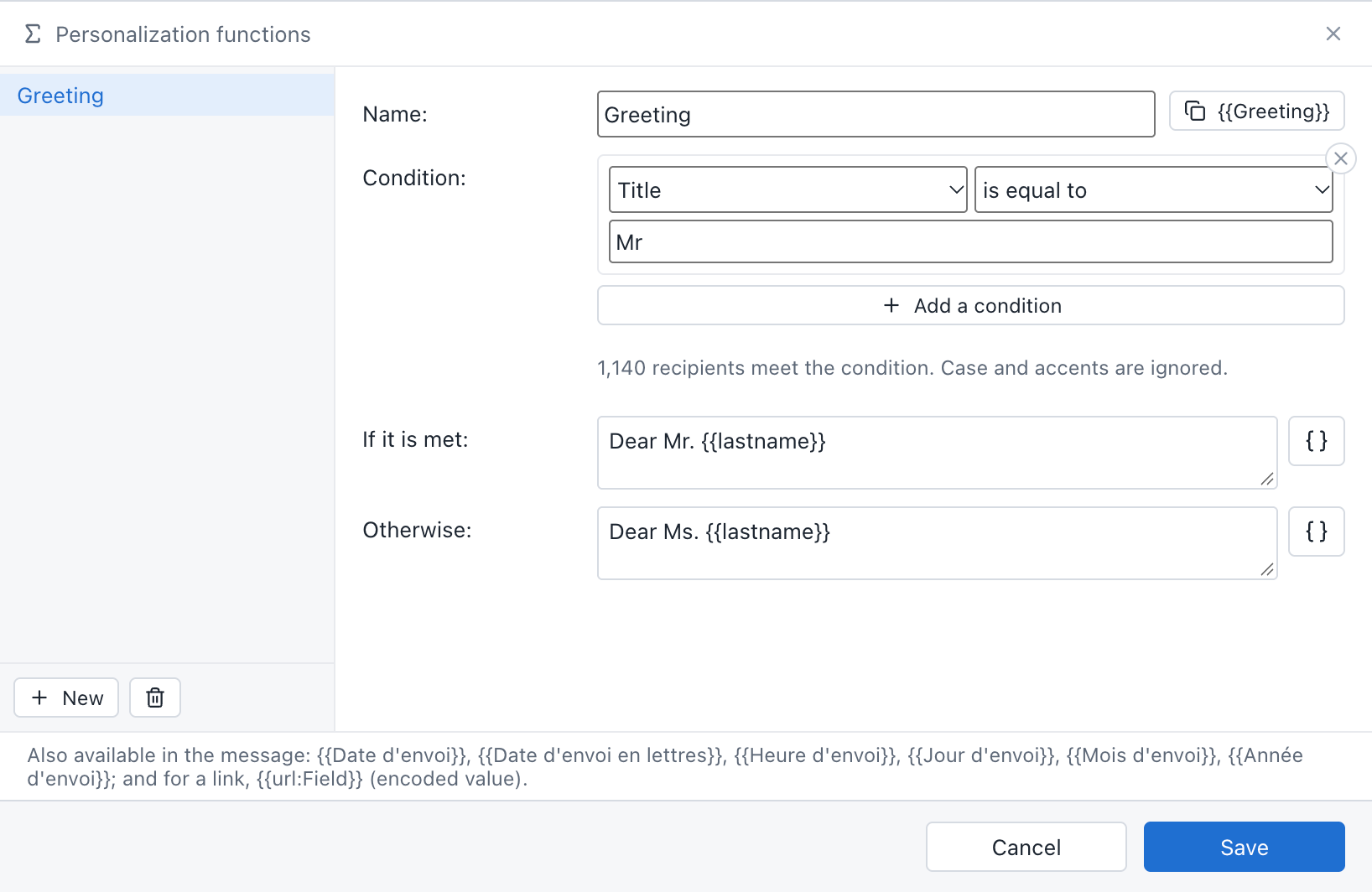
A function is defined in three parts:
- The name: it is what lets you insert the function into the message, as
{{Greeting}}(the button to the right of the name copies this code). - The condition: one or more conditions, each made of a field, a rule (“is equal to”, “contains”, “starts with”…) and a value. Case and accents are ignored. The number of recipients who meet the condition is shown right away.
- The texts: the one shown when the condition is met (“If it is met”), and the one shown otherwise (“Otherwise”). They can themselves contain fields.
For our example:
- Name: “Greeting”
- Condition: “Title” is equal to “Mr”
- If it is met: “Dear Mr.
{{lastname}}” - Otherwise: “Dear Ms.
{{lastname}}”
Click “Save”. The function then appears in the list of fields (the ”{ }” button of the subject and of the text toolbar in the editor), like an ordinary field.
Good to know: the sending date and time are also available ({{Send date}}, {{Send date in words}}, {{Send time}}…). The French names ({{Date d'envoi}}…) keep working.